

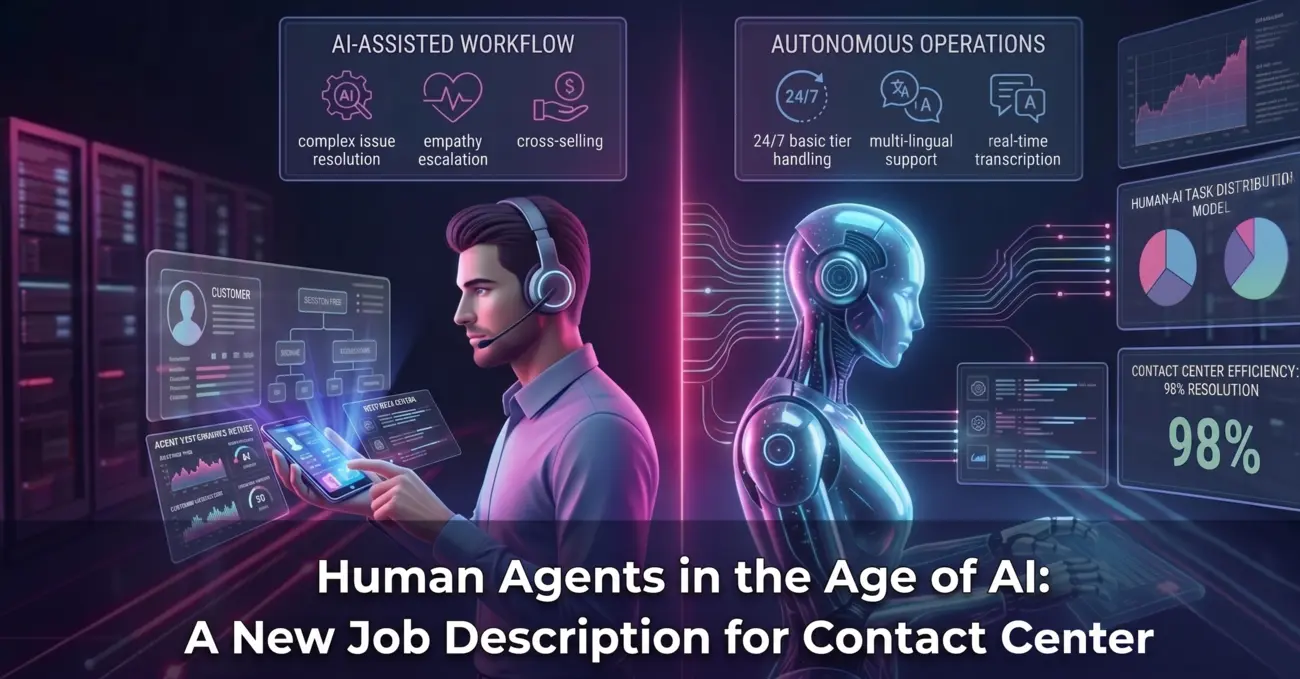
The contact center industry has heard this prediction before: AI will make human agents obsolete.
IVR menus were supposed to end the call center. Chatbots were supposed to replace live agents. Now, AI voice agents capable of holding natural, human-like conversations around the clock are driving the same debate, louder than ever.
The concern is valid. The conclusion is wrong.
When email arrived, nobody asked whether it would replace customer service reps. The real question was about task distribution: which work shifts to the new tool, and which work becomes more important for humans as a result?
That same question now applies to AI systems and contact center operations. The leaders who answer it clearly will not just survive the AI transition, they will build the strongest customer support teams they have ever had.
What AI Voice Agents Handle Best
AI voice agents excel at a specific category of customer interactions: high-volume, routine, low-stakes conversations that follow consistent patterns.
Consider the customer inquiries filling your queues today. A significant share will fall into familiar categories:
- Appointment confirmations and reminders
- Order status and delivery tracking
- Account balance or payment inquiries
- FAQ-style questions with a defined set of correct answers
- First-level triage to collect customer data before routing to the right team
For these customer interactions, AI systems are not just capable, they are often the better choice.
AI technology is available 24/7, handles multiple simultaneous calls without delay, and never gives a customer a poor experience because of a bad shift. With modern natural language processing, these interactions feel natural to the customer, not robotic.
ZIWO's AI Voice Agent automates exactly this category of routine calls, freeing your human team to concentrate on work that requires real judgment.
'The question is not whether AI will handle customer inquiries. AI systems already do. The question is which calls they handle, and what that means for live agents.'
Where Human Agents Become Indispensable
Here is where AI and humans diverge sharply.
A customer calls in distress because a payment failure has put their rent at risk. A high-value client is ready to leave after a service breakdown. A patient is confused and frightened about a medical bill. An elderly caller needs someone to walk them through a process, step by step, with patience.
These are not rare edge cases. They are the moments that define your brand and they require human intervention.
Human agents bring something AI technology cannot replicate: genuine judgment, emotional intelligence, and the ability to respond in ways that feel authentically caring. Customer sentiment in these moments is shaped entirely by the quality of the human on the other end.
These skills do not lose value when AI systems absorb routine tasks. They gain value because the live agents who remain are handling only the interactions where human presence truly matters.
As AI handles repetitive tasks across contact center operations, what surfaces for human agents is a queue of harder, higher-stakes, more emotionally complex conversations. The role does not shrink. The job description changes.
The Structural Shift Already Underway: Agents as Tier-2 by Default
For contact centers that have deployed AI voice agents, this transition has already begun and it is creating a challenge many operations leaders have not yet addressed.
When AI systems absorb routine customer interactions, every call that reaches a live agent becomes, by definition, a call the AI could not resolve. Human agents become a structural tier-2 team: handling the most complex, most emotionally charged, most difficult customer inquiries in the queue.
This shift carries real consequences for contact center operations:
- Burnout risk rises. A full shift of escalated, difficult calls, with no routine interactions in between, places a heavier cognitive and emotional load on agents than a mixed queue does.
- Training priorities change. Live agents need stronger skills in de-escalation, empathy, complex problem-solving, and judgment. Product knowledge alone no longer defines a strong performer.
- Legacy KPIs no longer fit. Metrics like average handle time were built for high-volume, mixed queues. They do not reflect performance fairly when every call is a hard one.
- Role expectations evolve. When human agents handle only the most complex customer support work, the position looks less like an entry-level role and more like a specialist function with compensation expectations to match.
'Deploy AI without redesigning the human side of your contact center operations, and you will get worse outcomes — not better ones.'
What Effective CX Leaders Are Doing Now
Organizations getting this right are not simply deploying AI technology and stepping back. They are actively redesigning their human operations in parallel, treating the AI transition as a full restructuring of how customer support works.
Redesigning the AI-to-human handoff
The moment an AI voice agent transfers a call to a live agent is a pivotal one in the customer experience.
When the handoff works well, customers feel continuous support. When it fails, customers feel bounced around, forced to repeat their situation from scratch. Leading teams design this transition with care, ensuring the AI passes customer data, call context, and customer sentiment signals to the live agent before the conversation begins. This is where AI and humans genuinely work together.
Building stronger coaching infrastructure
When live agents handle the hardest calls, the cost of coaching gaps rises, and so does the return on strong coaching.
Forward-thinking operations leaders use AI-powered quality assurance tools to evaluate 100% of calls, not a 5% sample. This approach gives supervisors a complete view of agent performance across all customer interactions, making coaching targeted and specific rather than based on assumptions.
Rethinking how success gets measured
Customer satisfaction scores, first-contact resolution on escalated issues, and customer effort scores are becoming the metrics that matter most in AI-augmented contact centers.
Handle time targets — built to manage volume — need to be reconsidered when AI systems have already absorbed most of the volume. Contact center operations should reflect the new reality: human agents are doing harder work, and the metrics should capture that.
Augmentation, Not Replacement: The Framework That Works
The framing of 'AI vs. human agents' has never been accurate. What generative AI and agentic AI make possible is a division of labor that, when structured well, raises performance on both sides.
AI systems handle the volume. Live agents handle the value.
The two work together: AI technology routing calls, collecting customer data, analyzing customer sentiment, and briefing the human agent; the live agent applying judgment, empathy, and expertise to resolve what the AI could not. Neither replaces the other. Each makes the other more effective.
This is the model ZIWO is designed around. The AI Voice Agent manages routine customer interactions end-to-end. AI Call Quality Scoring gives operations leaders visibility across all customer inquiries, not a sample. Together, they create the conditions for human agents to perform at their best.
The Bottom Line
The future of call center agents is not elimination. The role is being redefined and that redefinition is accelerating faster than most contact center operations are ready for.
The skills that made a strong agent in a traditional mixed queue remain necessary. They are no longer sufficient. What contact center operations need now are agents who are resilient, skilled in complexity, capable of handling elevated customer expectations, and supported by AI technology that sharpens their performance rather than simply replacing their tasks.
The leaders who invest in their human teams as seriously as they invest in their AI systems will build something neither can achieve alone: a customer support operation that is faster, more consistent, and more human where it counts.
The human agent is not dead. The human agent is being asked, finally, to do the work that only humans can do.
Frequently Asked Questions
Will AI replace human contact center agents?
AI systems will replace certain tasks — specifically high-volume, routine customer inquiries that follow predictable patterns. They will not replace human agents. Live agents are becoming more important for complex customer interactions, emotionally sensitive situations, and cases that require genuine judgment. The future of call center agents is not fewer roles, but different roles.
What is the difference between AI voice agents and live agents?
AI voice agents use natural language processing and machine learning to handle structured customer interactions automatically — available 24/7 with no wait time. Live agents bring human judgment, emotional intelligence, and the ability to respond to unpredictable or high-stakes situations. In an effective contact center, both work together: AI handles repetitive tasks, humans handle the interactions where customer sentiment and complex problem-solving matter most.
How does an AI voice agent hand off to a human agent?
In a well-designed contact center, the AI voice agent collects customer data and context during the initial interaction, then transfers the call to a live agent along with a summary of the conversation, the customer's issue, and sentiment analysis signals. This allows the human agent to engage immediately without asking the customer to repeat themselves — a key factor in customer experience and first-contact resolution.
How should contact center KPIs change when AI is introduced?
Traditional metrics like average handle time were built for high-volume, mixed queues. When AI systems absorb routine customer inquiries, live agents handle a higher concentration of complex calls. Contact center operations should shift focus toward customer satisfaction scores, first-contact resolution on escalated issues, customer effort scores, and agent wellbeing metrics — measures that reflect the true nature of the work human agents now perform.
Ready to see how ZIWO's AI Voice Agent and AI Call Quality Scoring work together in practice? Book a demo and see what AI augmentation looks like for your contact center operations.


