

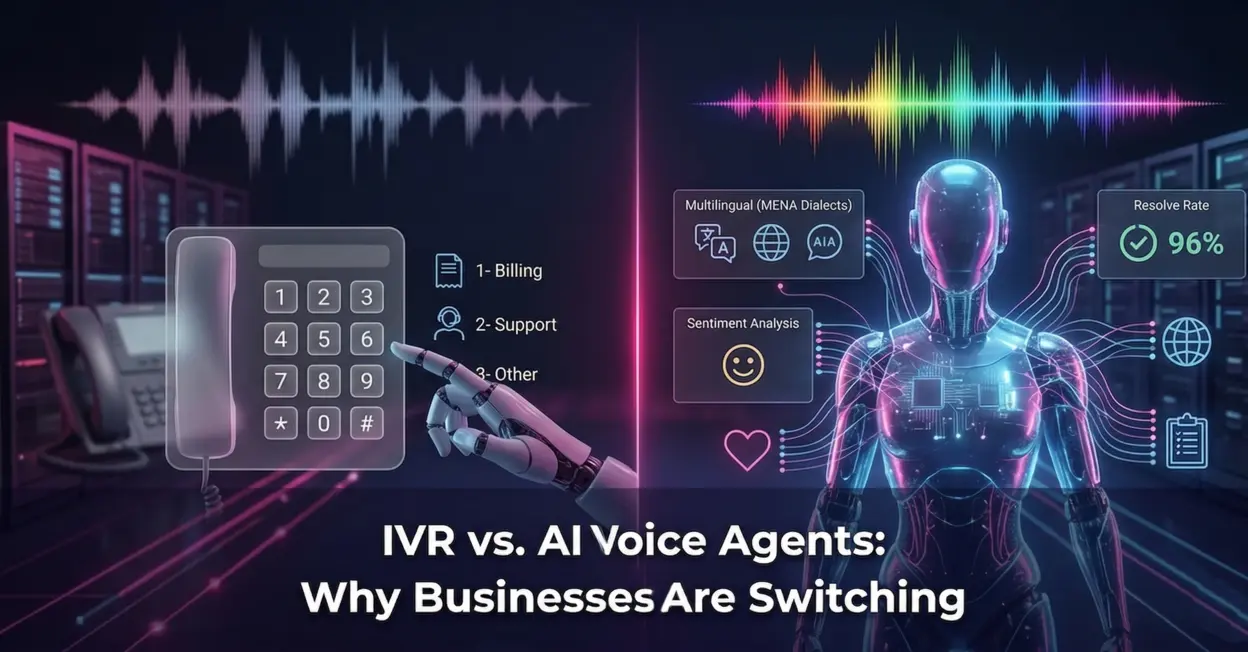
But that is no longer true. AI voice agents have changed the game. Companies across the MENA region and beyond are replacing their old IVR systems with AI-powered options – and the results are hard to ignore.
So what is actually different? And is the switch worth it for your business? Let us break it down.
What Is IVR – and Why Did We Ever Use It?
IVR systems changed how businesses handled calls when they launched. Businesses could route calls using touch-tone menus, with no human agent needed.
Need to check your balance? Press 1. Want to hear your order status? Press 2. Simple, scalable, and cheap to run.
For a long time, this was good enough. Call volumes were lower, customer expectations were different, and the alternative – hiring more agents – was expensive.
But the world moved on. Customers now expect fast, natural, and personalized service.
They call about complex issues. They speak in dialects. They switch languages mid-sentence. They hang up the moment they feel unheard.
IVR never had to handle any of that – and it shows.
The Real Problem with IVR in 2026
The limitations of IVR are not just cosmetic. They hit customer satisfaction, agent workload, and your bottom line.
It is rigid by design. IVR follows fixed menus and pre-recorded scripts. It can only do what it was programmed to do. When a customer's question falls outside the script – and most real questions do – the system fails. The caller gets stuck in a loop or bounces to a support team member, defeating the whole point of automation.
It cannot understand natural language. Most IVR systems need callers to press a number or say one keyword. They cannot follow a sentence or handle context. Say something like 'Actually, it is about the delivery, not the billing' and almost any IVR breaks. Natural language processing (NLP) is simply not part of how IVR works.
It creates a bad first impression. Long IVR menus increase abandonment rates and push up wait times. Customers who hang up are not just annoyed – you often lose them for good.
It cannot handle emotion. If a customer is upset, an IVR system has no way to detect that or respond properly. The caller gets the same robotic menu regardless of how they feel.
For businesses in the MENA region, there is one more gap: most IVR systems were not built with Arabic in mind. They handle Modern Standard Arabic poorly, and regional dialects – Khaleeji, Levantine, Egyptian – barely at all.
What AI Voice Agents Actually Do Differently
An AI voice agent is not a smarter IVR. It is a completely different technology.
Instead of menus, it holds a real conversation. Instead of keywords, it understands intent. It resolves calls in natural language – no button presses, no human required.
Here is what that looks like in practice:
Natural, multi-turn conversations. A customer can explain their issue the way they would to a human. The AI tracks context across the whole call, asks follow-up questions, and adjusts in real time based on what the caller says. No need to press anything or repeat yourself.
Real-time sentiment detection. Advanced AI voice agents detect frustration, confusion, or urgency as a call unfolds. If a customer's tone shifts, the system adapts – offering to escalate before things get worse. IVR cannot do this at all, and it is one of the biggest drivers of reduced wait times and higher satisfaction.
Genuine multilingual support. ZIWO's AI Voice Agent speaks naturally in Arabic, English, and French – including KSA and UAE dialects. This is not a generic Arabic overlay. It is built for how people in the region actually speak, making it a true service operation tool for MENA businesses.
24/7 availability without added cost. AI voice agents handle unlimited call volumes at any hour, without breaks or shift premiums. For outbound calls – reminders, confirmations, follow-ups – the efficiency gains are ones IVR cannot match. These automation workflows free your customer service teams to focus on what matters most.
Actionable insights after every call. Every interaction generates post-call analytics, a call summary, full transcript, and structured data that feeds into your CRM and knowledge bases. Every call becomes a source of real-time insights – with no manual effort from your team, and a system that is always improving.
Why the Switch Is Happening Now
For years, AI voice technology was costly and inconsistent enough that businesses stuck with what they knew. That has changed.
Modern platforms like ZIWO have made deployment fast. A no-code setup and pre-built templates mean a virtual agent can go live and handle calls the same day – no developer required. ZIWO customers report up to a 32% increase in sales success and up to a 59% reduction in churn intention. When those numbers land on a CFO's desk, the IVR renewal conversation gets very short.
The rise of agentic AI has also changed what is possible. Today's AI voice agents can make decisions mid-call – checking account information, adjusting their approach, and handing off to a human agent with full context. This is a custom conversational experience at scale, and it is why businesses that piloted AI voice two years ago are now expanding it across their contact center operations.
Data residency concerns – a real blocker for MENA businesses in the past – have also been resolved. ZIWO hosts data locally and meets regional regulations, including those for finance and healthcare. For businesses that could not adopt AI voice for compliance reasons, that barrier is now gone.
Is IVR Ever Still the Right Choice?
To be fair: IVR still works in some narrow use cases. If your call flow is simple – one menu, a few options, low volume – switching may not be urgent.
But for most businesses dealing with real call volumes and varied customer needs? IVR is a ceiling, not a foundation.
Making the Switch: What to Think About First
Switching from IVR to an AI voice agent is not as complex as it sounds, but it does need honest preparation.
Define what to automate first. Which call types make up your highest volume? Which cause the most friction? Start there. AI voice agents deliver the most value when focused on specific, high-frequency use cases. From there, you can automate routine tasks and expand across your service operation.
Test language performance with real scenarios. Especially in the MENA region, ask for a live demo in the dialects your customers use. Any vendor confident in their capabilities will welcome this.
Think beyond inbound. AI voice opens up outbound automation that IVR never could. Payment reminders, appointment confirmations, proactive follow-ups – these deliver fast, measurable ROI.
Choose a platform built for customized experiences. Look for an omnichannel ai platform that lets your team build custom conversational flows, connect to knowledge bases, and update scripts without needing a developer. That flexibility is key to a service operation that can adapt as your business grows.
Involve your agents early. The people on the phones every day know what breaks, what customers ask, and what the current system cannot handle. Their input improves the deployment – and their buy-in speeds up adoption.
The Bottom Line
IVR was the right tool for a different era. In 2026, it is a bottleneck dressed up as a solution.
AI voice agents do not just automate calls – they improve them. They understand customers, adapt to context, detect emotion, and deliver actionable insights with every interaction. For businesses in the MENA region, a platform built for local languages and local compliance requirements makes the case even stronger.
The question for most businesses is no longer whether to make the switch. It is how quickly they can do it without losing ground to competitors who already have.
If you are evaluating your options, our AI Customer Service Buyer's Guide is a good place to start – it covers the key features to look for, the questions to ask every vendor, and the common mistakes buyers make.
Frequently Asked Questions
What is the main difference between IVR and an AI voice agent?
IVR follows fixed menus and scripts. It can only do what it was programmed to do. An AI voice agent understands natural language, tracks context across a full conversation, and handles complex queries – all without a human stepping in.
Can AI voice agents fully replace human agents?
No – and the best platforms are not trying to. AI voice agents handle high-volume, routine tasks, freeing your support team for complex, relationship-driven conversations. The goal is to automate routine interactions so your agents spend time where it actually matters.
How long does it take to switch from IVR to an AI voice agent?
With modern no-code platforms like ZIWO, an AI voice agent can go live the same day. There is no long configuration cycle or developer requirement. Most businesses see measurable improvements in cost and customer satisfaction within the first few months.
Is multilingual support important for MENA businesses?
Critically so. Most customer interactions in the region happen in dialect – not Modern Standard Arabic. Platforms without real multilingual support will fail to automate a large share of your call volume. Always test this with a live demo before deciding.
What happens to the data from AI voice agent calls?
Every call generates a full transcript, call summary, and structured data that feeds into your CRM and reporting tools. For businesses in regulated industries, confirm that your vendor offers local data hosting and meets regional compliance requirements.


